Historical Structural Racism
Research examining how historical racial exclusion, segregation, racial violence, and institutional practices continue to shape contemporary social and health conditions.
Dr. Leia D. Belt, PhD
Dr. Belt is a sociologist and population health researcher studying how historical and contemporary systems shape health, opportunity, and inequality across place.
Her research brings together population data, spatial analysis, oral histories, interviews, archival research, community-engaged methods, and digital scholarship to investigate how structural conditions become embodied across generations and communities.
Sociology · Population Health · Structural Racism · Place · Maternal Health · Mixed Methods

About
Dr. Leia D. Belt is an interdisciplinary sociologist and population health scholar whose work investigates how historical systems of exclusion continue to influence contemporary communities, institutions, environments, and health. Her research moves between historical and contemporary evidence, and across methodological traditions — treating a research question, not a discipline's default toolkit, as the thing that determines method.
That range shows up in the evidence she works with: population health data and administrative records sit alongside oral histories, interview transcripts, PhotoVoice images, archival documents, and geographic and spatial data. She is as comfortable in a historical archive as she is with a multilevel regression model — and treats both as necessary for understanding how structural conditions become embodied, generation after generation, in specific places.
Throughout, she is concerned with research that is not only methodologically rigorous but meaningful to the communities represented in the data — work developed with communities, not simply conducted on them.
Training & pathway. Dr. Belt holds a Ph.D. in Interdisciplinary Studies — a designed emphasis in Sociology, History, and Public Health — from the University of Iowa (2023), an M.A. in Sociology from the University of Iowa (2020), and a B.S. in Psychology and Sociology, with honors, from Kent State University (2017), where she was a Ronald E. McNair Scholar. Her dissertation, "Sundown Towns and Contemporary Maternal Infant Health: An Interdisciplinary Mixed-Methods Analysis of Structural Racism and Its Public Health Legacy in the Midwest," laid the foundation for her ongoing sundown-towns research program.
Fellowships & training. She is a Health Affairs Equity Fellow (2024–2025), an AcademyHealth Health Data Policy Fellow (2024), and a graduate of the National Endowment for the Humanities' Born-Digital Scholarly Publishing Institute at Brown University Library (2024) — training that directly informs the born-digital book project below.
Postdoctoral research. Before her current appointment, she was a Postdoctoral Scholar in the Department of Sociology and the Higher Education Race & The Economy (HERE) Lab at UC Merced (2023–2025).
Research Philosophy
Health is shaped not only by individual behavior or healthcare access but by the histories, policies, institutions, economies, environments, and relationships embedded in place. Understanding contemporary health therefore requires asking how communities came to look the way they do — and who had the power to determine that development.
Investigate the policies, institutions, racial hierarchies, and historical events that produced contemporary places.
Examine how those histories become embedded in neighborhoods, towns, rural communities, infrastructure, environments, and access to resources.
Study how those structural conditions shape population health, maternal and infant health, well-being, and access to care.
Combine population-level evidence with the experiences, knowledge, memories, and priorities of people living within those places.
Core Research Areas
Each area below is a distinct body of work — connected by the same underlying question about how history and place produce health.
Research examining how historical racial exclusion, segregation, racial violence, and institutional practices continue to shape contemporary social and health conditions.
Research investigating the historical geography and contemporary consequences of sundown towns and racially exclusionary jurisdictions across the United States.
Research examining how structural conditions, geography, healthcare access, racial inequality, and historical context shape maternal and infant health.
Research examining rural places as historically and socially produced environments — rather than treating "rurality" as simply a demographic classification.
Research examining how political, social, economic, commercial, historical, and institutional forces shape population health — the systems that produce downstream social conditions, not just the conditions themselves.
Work developed with communities rather than simply conducted on them.
Research that transforms complex academic evidence into accessible digital scholarship through interactive maps, public databases, StoryMaps, data dashboards, digital books, and oral-history archives.
The Geography of Exclusion
This body of scholarship investigates how historically racially exclusionary places — sundown towns and similar jurisdictions that used law, custom, threat, and violence to exclude Black residents — may continue to structure health, opportunity, resources, community life, and inequality today. The research question is not only historical: it asks how that exclusion persists through contemporary systems, and what that persistence means for the people living in and near those places now.
Locating sundown towns and exclusionary jurisdictions using historical records, newspapers, and geographic databases.
Linking that historical geography to contemporary population health and demographic outcomes.
Gathering oral histories and community knowledge from people who lived this geography.
Identifying the transportation corridors, institutions, and policies that carried exclusion forward.
Assembling historical documents, photographs, and records into a lasting, shareable public resource.
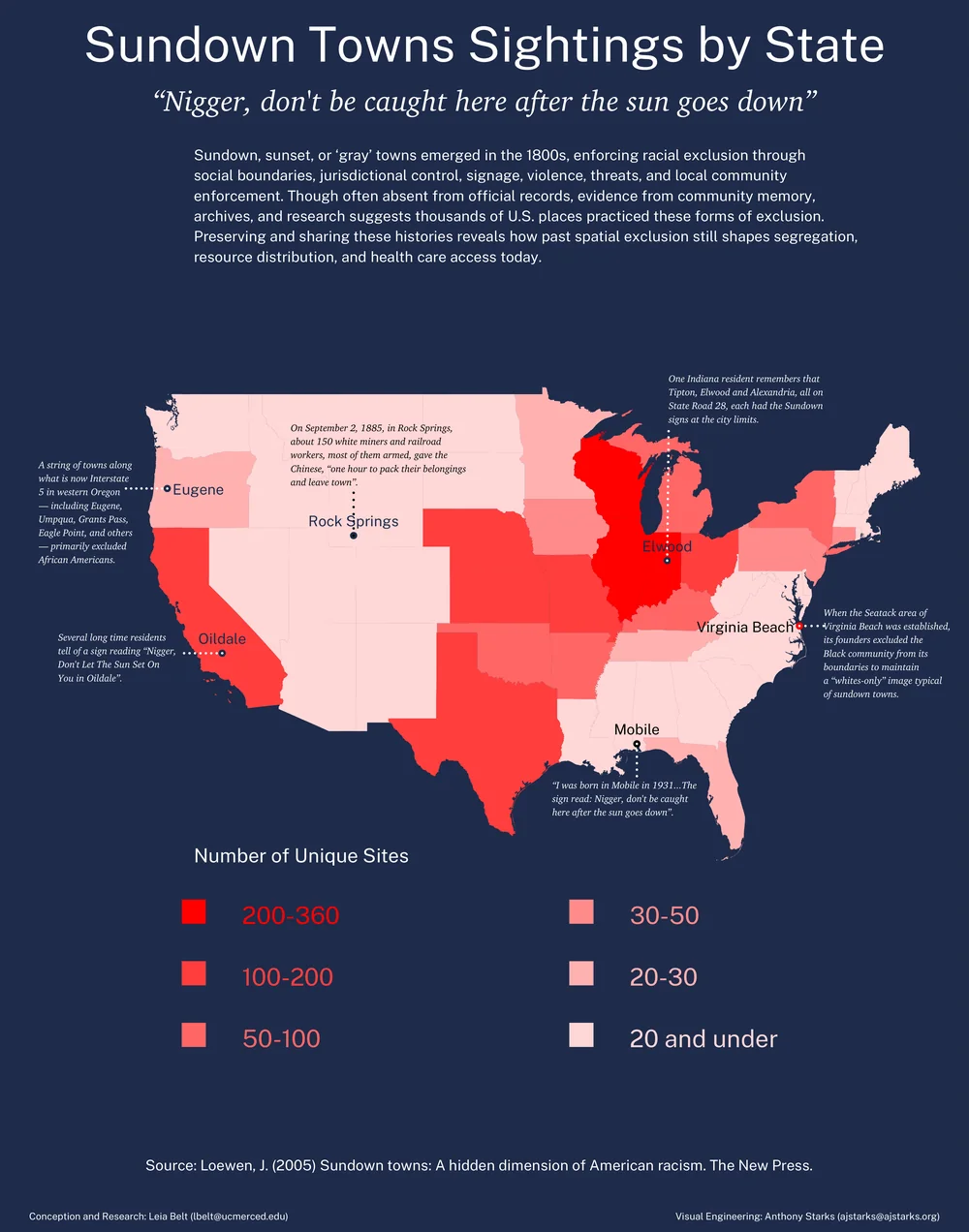
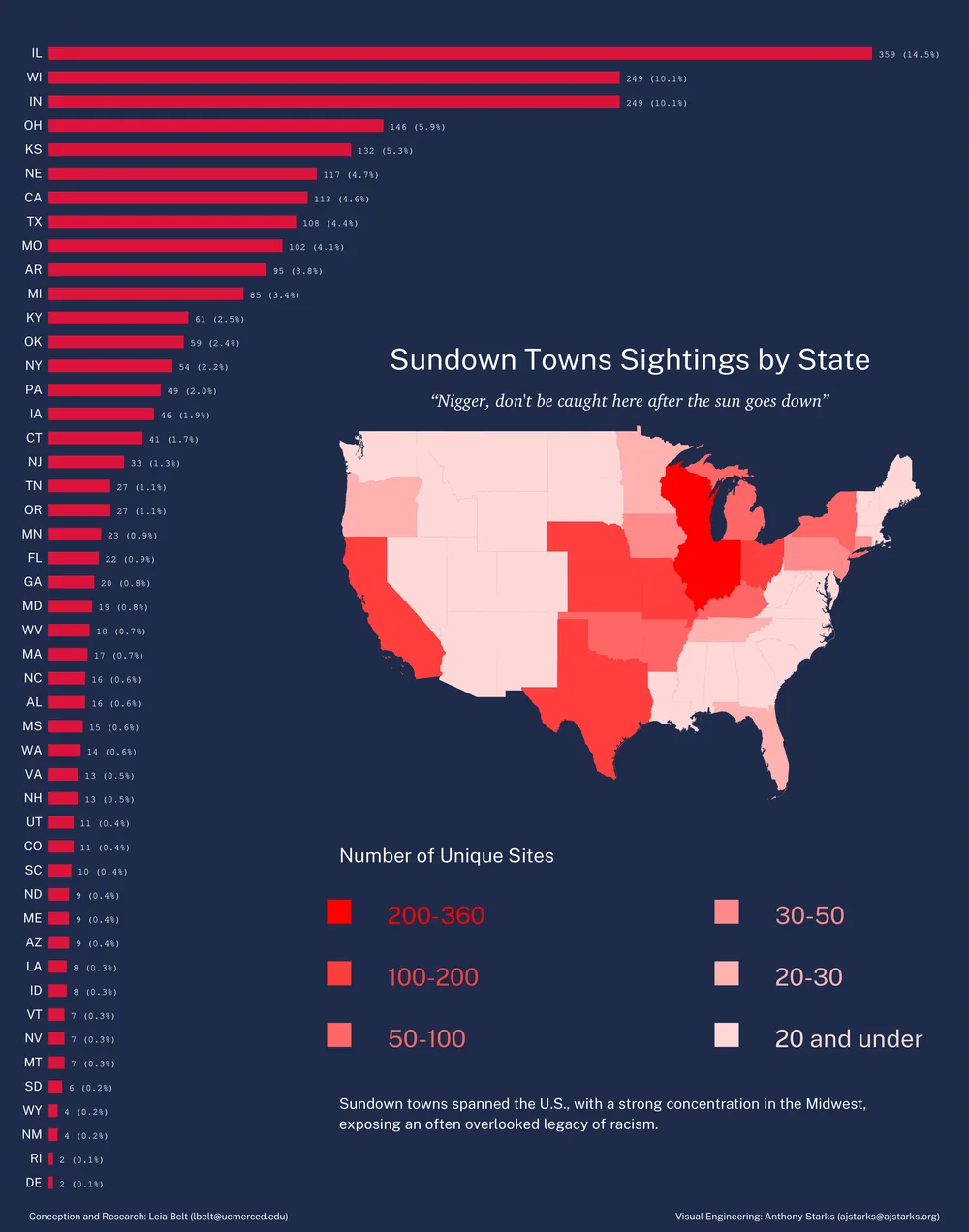
Map source: Loewen, J. (2005). Sundown Towns: A Hidden Dimension of American Racism. The New Press. Conception & research: Leia Belt. Visual engineering: Anthony Starks. Remaining slots are placeholders — add only with appropriate permissions and citation.
Digital Scholarship
Book in DevelopmentDr. Belt is developing a born-digital scholarly project that combines narrative scholarship with interactive maps, historical records, oral histories, population health research, data visualization, photography, archival materials, and audio — designed for a platform built for multimedia scholarly publishing, in the tradition of projects hosted on platforms like Fulcrum and university press digital imprints.
She trained for this work as a member of the National Endowment for the Humanities' Born-Digital Scholarly Publishing Institute at Brown University Library (2024). [ADD ACTUAL INFORMATION — working title, current stage, target platform/press once confirmed. No publisher has been confirmed to have accepted or contracted this project.]
Community-Engaged Public Health Data
In California's San Joaquin Valley and Sierra Foothills, Dr. Belt works on community-engaged public health data infrastructure — asking not only "what data should we collect?" but also "who should shape the data, interpret it, trust it, and ultimately own how it is used?"
This work sits at the intersection of public-facing health dashboards, community crowdsourcing, resource sharing, warm handoffs between services, community stewardship, institutional trust, co-design, and data sovereignty.
[ADD ACTUAL INFORMATION — partner organizations, project name, and any outcomes, once confirmed. No outcomes or metrics are stated here pending real data.]
Participatory & Qualitative Research
Dr. Belt's qualitative and participatory work uses PhotoVoice, oral history, key informant and expert interviews, semi-structured interviews, focus groups, and community listening sessions to examine experiences of health, place, birth, community, and structural conditions.
Photography, excerpts, and field materials above are placeholders. Participant quotations and images are added only with explicit permission — never fabricated.
Selected Projects
Each project below follows the shape of the research itself, rather than a one-size-fits-all case-study format.
Methods
Dr. Belt works across methodological traditions and selects methods based on what a research question requires — not the reverse.
Professional Experience
From Kent State to the University of Iowa to UC Merced — full details in the CV below.
University of California, Merced
Higher Education Race & The Economy (HERE) Lab · University of California, Merced
Designed emphasis in Sociology, History & Public Health · University of Iowa
Dissertation: "Sundown Towns and Contemporary Maternal Infant Health: An Interdisciplinary Mixed-Methods Analysis of Structural Racism and Its Public Health Legacy in the Midwest."
University of Iowa
Kent State University · Minor in American Sign Language · Ronald E. McNair Scholar
Publications & Scholarship
Filter by category or search by title. Drawn from Dr. Belt's CV (Fall 2026) — links marked [ADD ACTUAL LINK] still need a URL before launch.
Belt, L., Gomez-Vidal, C., Zahnd, W., Mutch, E., & Williams, J. — American Journal of Public Health
Oehmen, N. B., Haylett, J., Belt, L., & Clark, J. (2023) — Teaching Sociology
Belt, L. D., & Mutch, E. (2026) — Dryad [Data set]
Dorcoo, S., & Belt, L. (October 2024) — Lancet Race and Health Quarterly
Belt, L. (August 2024) — AcademyHealth
Belt, L., AcademyHealth (July 2024)
Belt, L., AcademyHealth — White House Office of Science and Technology Policy (July 2024)
Belt, L., & Spates, K. — Health Affairs Forefront
Belt, L. (2024) — American Public Health Association (APHA) Annual Meeting
Belt, L. (2024) — American Sociological Association (ASA) Annual Conference, Montreal
No publications match that search.
Full presentation and guest-lecture history in the CV above — this list is a representative selection, not the complete record.
Books & Major Projects
A born-digital scholarly book combining narrative, interactive maps, historical archives, oral history, and population health data. [ADD ACTUAL INFORMATION — current stage, target press/platform.] No publisher has confirmed acceptance of this project.
Speaking & Conversations
Dr. Belt has spoken at national conferences, university departments, and community convenings — including a keynote address for the "It Starts with US" Conference (Community Action Partnership Pennsylvania, 2024) — and is available for academic talks, guest lectures, panels, workshops, and community conversations.
Teaching & Mentorship
Dr. Belt's teaching areas connect directly to her research — a teaching philosophy statement and sample syllabi are still to come.
Mentorship: Undergraduate Student Success Internship (SSI) Mentorship Program, University of California, Merced (2024).
Teaching philosophy statement and sample syllabi: [ADD ACTUAL INFORMATION].
Ideas & Perspectives
A home for essays, commentary, interviews, and research reflections on place, health, race, history, maternal health, rural America, research methods, and community research.
New Thinking · Belt, Leia
Belt, Leia & Inderstrodt, J.
Inderstrodt, Jill & Belt, L.
Links to full pieces: [ADD ACTUAL LINK]. More of Dr. Belt's commentary and reports appear in the Publications section above.
Collaboration
Dr. Belt welcomes select opportunities involving research collaborations, interdisciplinary scholarship, community-engaged research, population health research, mixed-methods projects, historical and spatial research, digital scholarship, public-facing research infrastructure, academic and community partnerships, speaking, workshops, and research strategy and advising.
Contact
Share a bit about what you'd like to discuss — research collaboration, speaking, an academic opportunity, consulting, media, mentorship, or a community partnership — and Dr. Belt will follow up.